
How to verify client identity

March 5, 2024


In today's dynamic digital ecosystem, ensuring the security and integrity of business transactions has escalated into a paramount concern. The digital age has ushered in unparalleled conveniences and efficiencies in conducting business; however, it also brings with it a shadow of cyber threats and identity fraud risks that lurk at every corner. Verifying the identity of your clients isn't merely a regulatory tick-box exercise—it's a critical bulwark in protecting the sanctity of your business operations against these threats.
This guide delves deeply into the essentials of client identity verification, seamlessly weaving in trending keywords and leveraging cutting-edge strategies to empower your business against potential vulnerabilities. As we progress, we will demystify the process of Know Your Customer (KYC) and spotlight an innovative solution by Dataleon, poised to revolutionize your approach to ensuring client authenticity.
Understanding client identity verification
Client identity verification emerges as a cornerstone in the architecture of modern business practices, involving a meticulous process to confirm the authenticity of a client's claimed identity. Beyond a mere regulatory formality, it stands as a fundamental pillar to assure the safety, security, and trustworthiness of your business dealings in a landscape increasingly marred by data breaches and sophisticated fraud attempts. In such a context, having a robust and reliable process for verifying the identities of your clients can starkly delineate the boundary between thriving securely and navigating through perpetual vulnerabilities.
Why is it essential?
- Combat fraud: Implementing a rigorous client identity verification process establishes a formidable frontline defense against potential fraudsters who aim to infiltrate your business ecosystem. This not only protects your operational integrity but also safeguards your clients' sensitive information from falling into the wrong hands.
- Regulatory compliance: In an era where legal frameworks around data protection and financial transactions are becoming increasingly stringent, many industries find themselves under the obligation to perform thorough KYC checks. These checks are not just about compliance; they are integral to the global fight against money laundering, terrorist financing, and other illicit financial activities.
- Trust and reputation: The reputation of your business is intricately tied to how securely you can handle client information and transactions. Establishing a reliable and efficient verification process not only positions you as a secure and trustworthy partner in the eyes of your clients but also builds a foundation of trust that is critical for long-term business relationships.
Exploring KYC: The key to unlocking client trust
KYC, which stands for Know Your Customer, is a regulatory and security framework that mandates businesses to verify the identity of their clients. This process is fundamental in preventing identity theft, financial fraud, money laundering, and terrorist financing. A robust KYC process is the cornerstone of a secure business environment, ensuring that businesses can trust their clients and vice versa. It not only meets the regulatory mandates but also establishes a framework of trust that enhances customer relationships and ensures the integrity of financial transactions.
Components of a strong KYC Process
- Customer Identification Program (CIP): This is the initial step where businesses collect and verify information to establish the identity of their clients. It involves gathering documents, data, and other corroborative evidence that can confirm the client's identity beyond doubt.
- Customer Due Diligence (CDD): This step involves evaluating the risk a client may pose before establishing a business relationship. The extent of due diligence is determined by the level of risk perceived, ensuring that higher-risk clients undergo more rigorous scrutiny.
- Ongoing Monitoring: The KYC process does not end with the initial verification. Regularly reviewing and updating client information is crucial to catching any suspicious activity early on. This ongoing monitoring ensures that businesses can respond swiftly to potential threats and maintain the integrity of their operations.
Leveraging technology in KYC
The digital revolution has transformed KYC processes from cumbersome, manual checks to highly sophisticated digital solutions. Modern technologies, such as artificial intelligence, machine learning, and blockchain, have been leveraged to enhance the accuracy, efficiency, and reliability of identity verification processes. These technologies not only streamline the verification process but also significantly reduce the potential for human error, making KYC checks more reliable and less intrusive for clients.
Introducing Dataleon's revolutionary KYC solution
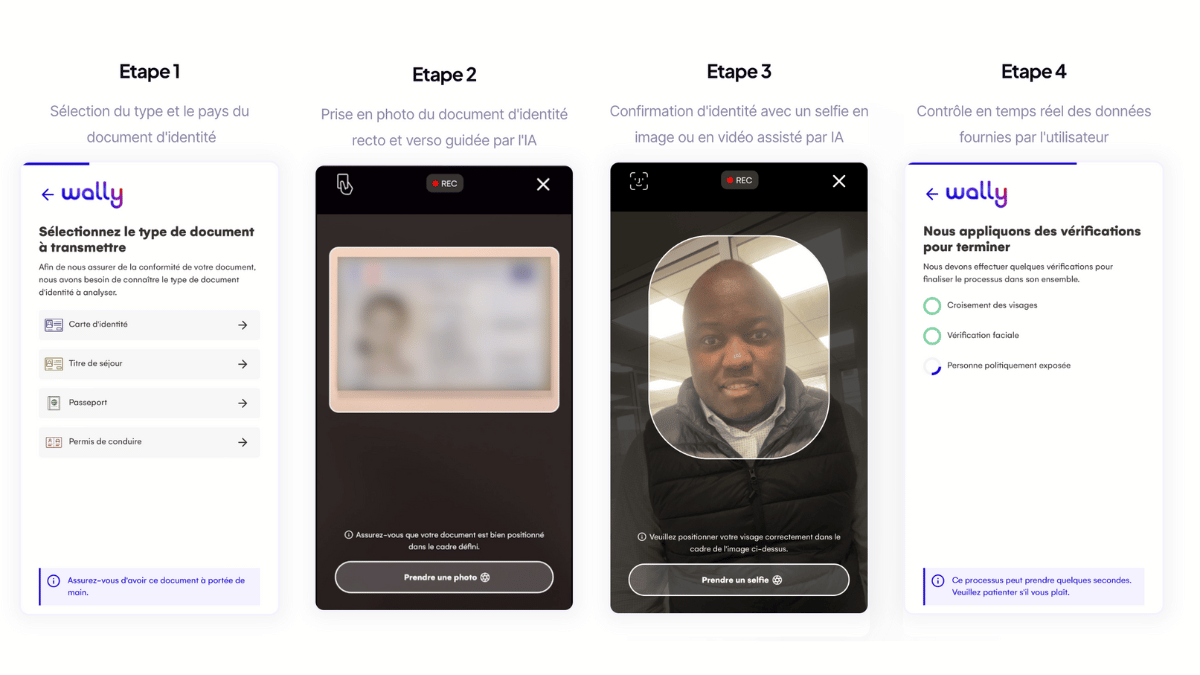
Dive into a transformed KYC experience with Dataleon. Our solution utilizes a four-step approach, driven by artificial intelligence, for hassle-free instant identity verification via image or video. Each step is meticulously designed to ensure security and compliance while optimizing the user experience:
- Selection and compliance: The process begins by selecting the type of document, ensuring that compliance is established from the very first step.
- Guided capture: Dataleon's AI guides the user in capturing photos of the document, ensuring optimal clarity for verification.
- Assisted identity confirmation: A selfie or a video, aided by AI, confirms that the user's identity matches the provided documents.
- Real-time verification: Finally, the provided data are analyzed in real-time for final verification, completing the process efficiently.
At Dataleon, we do more than just verify identity; we redefine efficiency and security in the KYC process. Our solution is the ideal partner for businesses that value precision, speed, and customer satisfaction. Experience an identity verification process that combines technological innovation with simplicity of use with Dataleon.
Conclusion
Navigating the intricate web of digital interactions in today's business landscape necessitates more than just compliance with regulatory standards; it demands a foundational commitment to securing the identity of your clients. Implementing a robust KYC process is not merely a defensive measure—it's a strategic investment in the trust and integrity of your business relationships. As we look towards a future where digital security challenges will only grow more complex, embracing innovative solutions like Dataleon's KYC tool becomes essential for businesses aiming to safeguard their operations and nurture trust with their clients. With Dataleon, businesses are empowered to not only meet but exceed the expectations of security and efficiency in client identity verification.
Auteur




Questions fréquemment posées
Dataleon propose-t-il une assistance ?

Oui. Chaque client bénéficie d'un accompagnement dédié : support technique par e-mail et visioconférence, documentation complète et exemples de code pour intégrer nos API. Nos ingénieurs vous aident à cadrer vos parcours KYC et KYB, à réaliser l'intégration puis à passer en production sans interruption de service. Un interlocuteur unique reste ensuite disponible pour suivre vos volumes, ajuster vos règles de contrôle et répondre à vos questions métier comme techniques.
Mes fichiers sont-ils supprimés après traitement ?
Oui. Vos documents sont chiffrés en transit comme au repos, traités puis supprimés automatiquement à l'issue de la durée de conservation que vous définissez. Vous restez seul propriétaire des données transmises : elles ne sont ni revendues ni utilisées à d'autres fins que la réalisation de vos contrôles. Vous pouvez aussi déclencher la suppression immédiate d'un dossier depuis l'interface ou via l'API, et ne conserver que les résultats d'analyse nécessaires à vos obligations de conformité.
Peut-on intégrer Dataleon à nos outils via API ?
Oui. Dataleon se connecte à votre système d'information via une API REST documentée, des webhooks temps réel et des connecteurs vers vos outils existants : CRM, core banking, GED ou solutions de signature électronique. Les parcours de vérification, les règles de scoring, les seuils de risque et les workflows de validation sont entièrement paramétrables afin de coller à vos procédures internes. Nos équipes peuvent également développer des traitements sur mesure lorsque votre cas d'usage l'exige.
Puis-je tester Dataleon avant de m'engager ?
Oui. Vous bénéficiez d'un essai gratuit de 15 jours, sans engagement, pour vérifier vos propres pièces d'identité, justificatifs et documents d'entreprise et mesurer la qualité de l'extraction et des contrôles KYC/KYB. Pendant ces 15 jours, vous accédez à l'interface ainsi qu'à des clés d'API de test afin de valider votre intégration technique de bout en bout. Nous proposons également une démonstration personnalisée avec un expert pour construire ensemble le parcours adapté à votre activité.
Êtes-vous conforme au RGPD avec des serveurs en France ?
Oui. Dataleon est conforme au RGPD et l'ensemble des traitements ainsi que le stockage des données sont réalisés en France, sur l'infrastructure de Scaleway, hébergeur souverain français. Nous appliquons le chiffrement des données en transit et au repos, la minimisation des informations collectées, une gestion fine des droits d'accès et une traçabilité complète des opérations. Un accord de traitement des données (DPA) et notre documentation de sécurité vous sont fournis pour faciliter vos audits internes et réglementaires.
L'automatisation qui rend la conformité invisible.
Dataleon, le chaînon manquant entre votre conformité et votre croissance. KYC, KYB, LCB-FT, enfin réunis au même endroit.
La conformité automatisée, du document à la décision



© 2026 Dataleon. Tous droits réservés.

